Orthognathic surgery · New Jersey
Corrective and Aesthetic Jaw Surgery
Jaw surgery planned for the face, the airway, and the bite at the same time. Dr. Subtelny designs each movement in three dimensions and coordinates the plan with your orthodontist. Chin refinement, custom jawline implants, or neck contouring can be added in the same operation.
Medically reviewed by Benjamin Subtelny, DDS, board-certified oral and maxillofacial surgeon
Approach
Form Follows Function
Corrective jaw surgery, also called orthognathic surgery, repositions the upper jaw, the lower jaw, the chin, or in most cases, a combination of all three. The jaws are the framework of the lower face, so every movement that corrects the bite also changes the profile, the chin, the jawline, the lips, and the airway behind the palate and tongue.
Dr. Subtelny plans those effects deliberately. Correcting the bite is the minimum every jaw operation must achieve. A plan that fixes the bite but flattens the face or buries the smile falls short. This surgery sets the foundation that the skin and soft tissues rest on, and proper skeletal support must be planned in to fight off gravity through aging. The direction and amount of each movement are chosen so that the smile, jawline, breathing, and bite all improve together. The goal is not a completely new you, but the balanced face and youthful smile that should have been there from the start.
Indications
Who It Helps
- Underbite, where the lower jaw sits ahead of the upper (Class III)
- Overbite with a small or retruded lower jaw (Class II)
- Open bite, where the front teeth do not meet
- Facial asymmetry, including a jaw that has grown to one side
- A long face or gummy smile
- A short face, deep bite, or too little tooth show
- A narrow upper jaw or crossbite
- A weak chin or soft jawline together with a bite problem
- Obstructive sleep apnea related to jaw position (sleep apnea surgery)
Many patients first notice difficulty biting or chewing, jaw strain, or wear on the teeth. Others are bothered first by their profile or their smile. Both are good reasons to be evaluated.
If your bite is already correct and your concern is the shape of your chin, jawline, or cheeks, custom facial implants may be used to enhance the facial skeleton without moving the jaws.
Facial analysis
What Is Measured
Every plan starts with an analysis of the face at rest and in animation, made in person, alongside standardized clinical photography and imaging. These measurements guide the direction and amount of each movement.
- Proportion and Symmetry
- The balance of the upper, middle, and lower thirds of the face, the facial midline, and any tilt of the bite or jaw.
- Profile
- Projection of the midface, lips, and chin, the angle between the nose and the upper lip, and the angle between the neck and the jawline.
- Soft Tissues
- The thickness and support of the lips, cheeks, and chin, and how they move with expression. They decide how a change in the bone shows on the surface.
- Smile
- How much tooth and gum show at rest and in a full smile, and the curve of the smile. The goal for the upper jaw is a smile that shows the full upper front teeth and a little gum, with the edges of the upper teeth following the curve of the lower lip and the center line of the teeth aligned with the dip of the cupid's bow at the center of the upper lip.
- Jawline and Neck
- Definition of the lower border and angle of the jaw, the angle between the chin and the neck, and fullness under the chin.
- Airway
- How the position and width of the jaws affect the space for the tongue and airway, nasal breathing, and any history of snoring or sleep apnea.
Procedures
The Operations
- LeFort I Osteotomy
- Repositions the upper jaw forward, up, down, or rotated. It sets tooth show, midface support, and the base of the nose, and it can be moved in one piece or in segments to widen or level the arch.
- Bilateral Sagittal Split Osteotomy (BSSO)
- Moves the lower jaw forward or back, or rotates it to correct asymmetry. It sets the position of the lower lip, chin, and jawline.
- Inverted-L Osteotomy
- Used in place of a sagittal split when height must be added at the back of the lower jaw to create a well-defined jaw angle, most often in patients with a long face. Other ramus osteotomies are used when a case calls for them.
- Double-Jaw Surgery
- Both jaws are moved in the same operation. Occasionally a patient is a good candidate for a single-jaw operation, but moving both jaws together gives a greater ability to fine-tune the final result.
- Genioplasty
- Repositions the chin in three dimensions, independently of the bite. When the attachments of the tongue muscles come forward with it (genial tubercle advancement), it also opens the airway behind the tongue.
- Nasal Airway Surgery
- Septoplasty and turbinate reduction can be performed in the same operation when nasal obstruction is part of the problem.
Incisions are made inside the mouth. The bones are held in their new position with titanium plates and screws. Elastics are used to guide the bite after surgery.
Planning
Planned to the Millimeter
Planning starts with your face, studied at rest and in a smile, from the front and in profile, along with a cone-beam CT scan and digital scans of the teeth. The movements are chosen to suit that face rather than to match textbook measurements. The surgery is then simulated in three dimensions, each movement is measured in millimeters, and custom plates are made from the scan. Dr. Subtelny reviews the planned movements with you before surgery, including how they are expected to change your profile.
Most corrective jaw surgery is done in partnership with an orthodontist. Braces or aligners before surgery position the teeth so the jaws can be moved into the correct bite, and a second phase after surgery finishes the result. Dr. Subtelny and your orthodontist agree on the goals early, before treatment begins. He plans the surgical movements himself, and your orthodontist is welcome to join the planning session before surgery. For the right candidates, an abbreviated or surgery-first sequence is possible, and that decision is made together.
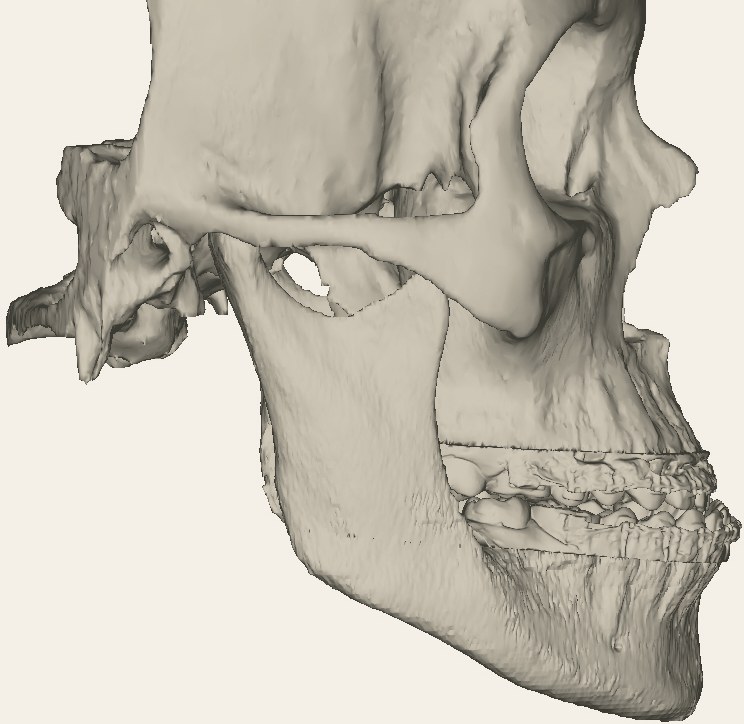 Before
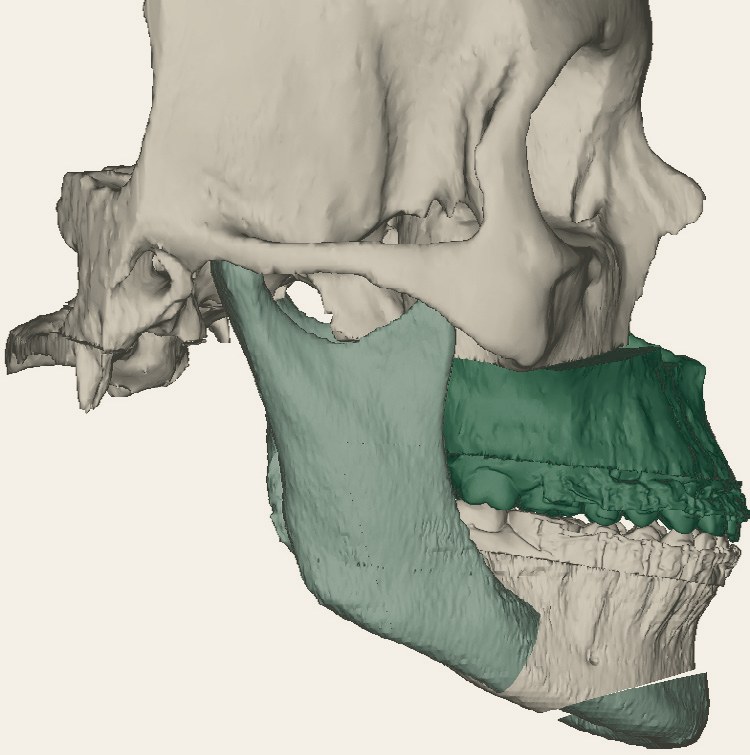 Planned
The nerve
Protecting the Nerve
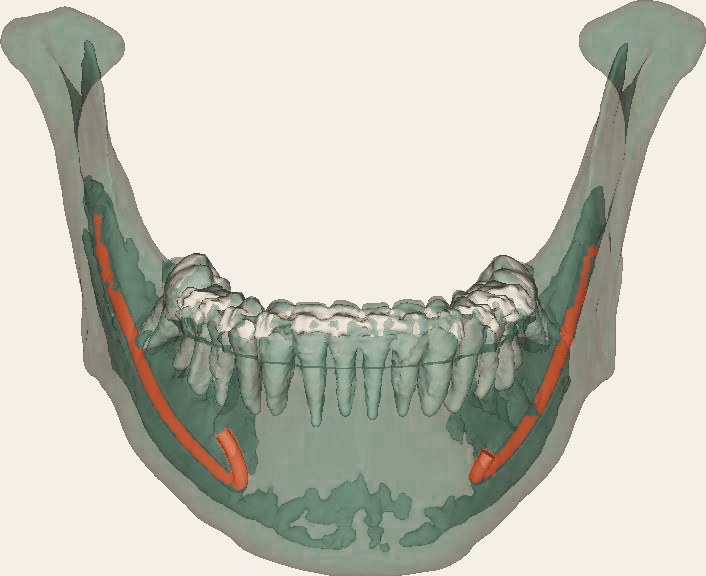
The inferior alveolar nerve runs through the lower jaw on each side and gives feeling to the lower lip, chin, and lower teeth. Lower jaw surgery is performed close to it, so its path is traced on your CT scan before surgery, from where it enters the jaw to where it exits toward the chin. The cuts are then designed around it, with the distance to the nerve measured where each cut is planned.
Temporary numbness of the face is still common after jaw surgery, mainly due to initial swelling, and it usually improves in the months following surgery. Mapping the nerve in advance is how the risk of lasting change is mitigated. Repair of these nerves is also part of Dr. Subtelny's practice, so he plans around them with particular care. Nerve repair
Refinement
Chin, Jawline, and Neck
Bringing the lower jaw and chin forward supports the soft tissue under the chin and sharpens the jawline on its own, within the limits of each patient’s natural jaw shape. When more refinement is desired, the procedures below can be added in the same operation.
- Genioplasty
- Fine-tunes the projection, height, and symmetry of the chin.
- Custom Jawline Implants
- Designed on the same surgical plan to add definition at the angle and lower border of the jaw where moving the bone does not. About custom implants
- Custom Cheek Implants
- Add projection to the cheekbones, which conventional jaw surgery can improve only modestly.
- Deep Neck Contouring
- Direct removal of the fat beneath the platysma, the thin muscle of the neck, to reduce fullness under the chin and sharpen the angle between the neck and the jawline.
Aesthetic additions are discussed and planned at consultation. They are never required for jaw surgery.
Recovery
What Recovery Looks Like
- Day of surgeryPerformed under general anesthesia at the hospital. Most patients stay one night.
- First weekSwelling peaks around the second or third day. A non-chew diet, ice for the first two to three days, elastics to help guide the bite, and prescribed medication.
- Weeks 2 to 6A gradual transition from soft to solid foods. Most people return to school or desk work in two to three weeks.
- Week 6Initial bone healing. Most patients are back to solid foods.
- Months 2 to 12Residual swelling resolves and the final facial contour emerges. Orthodontic finishing is completed.
Timelines vary from patient to patient and are reviewed in detail at consultation.
Insurance
Corrective jaw surgery is often covered by medical insurance when it treats a functional problem such as a malocclusion, difficulty chewing, or sleep apnea. Our office prepares the clinical documentation and requests prior authorization, and you will know your expected coverage before surgery is scheduled. Aesthetic additions such as implants or neck contouring are not covered by insurance and are quoted separately. Insurance and costs
Questions
Common Questions
Is orthognathic surgery the same as jaw surgery?
Yes. Orthognathic surgery is the medical term for corrective jaw surgery: repositioning the upper jaw, the lower jaw, the chin, or a combination to correct the bite, open the airway, and balance the face. Double jaw surgery means both jaws are moved in the same operation.
Will my face look different?
Usually yes, and the change is planned. The plan is designed to bring your face into balance, and you review the planned movements with Dr. Subtelny before surgery.
Can jaw surgery be done for appearance alone?
Yes. Many people who want jaw surgery for their appearance, such as for a weak chin, a long face, or a gummy smile, also have an underlying skeletal bite problem or a narrow airway, and correcting it improves both. When the bite and airway are already healthy, the jaws can still be moved for appearance, or custom implants, such as patient-specific PEEK implants, or a genioplasty can often create the look a patient desires without moving the jaws. Dr. Subtelny reviews these options at consultation. Surgery performed for appearance alone is not covered by insurance. Custom facial implants
How long will I need braces?
Total orthodontic treatment usually takes one to two years, though timeframes vary widely depending on the case. For the right candidates, surgery can come first or after a shorter period of orthodontics. Your orthodontist and Dr. Subtelny will give you an estimate for your case.
How painful is jaw surgery?
Most patients describe the first days as pressure and swelling more than pain. The face is often numb at first. Much of the discomfort feels like a bad head cold, from congested sinuses and from breathing, eating, and talking through the mouth, where the surgery was performed. Dr. Subtelny takes deliberate steps during and after surgery to limit swelling, and discomfort is managed with non-opioid medication and, when needed, a short course of prescription medication.
How old do I need to be?
Surgery is usually performed once facial growth is complete, typically around 15 to 17 for young women and 17 to 19 for young men, but this is evaluated on a case-by-case basis. Earlier surgery is sometimes considered for airway compromise, or specific TMJ or growth problems.
Do I need a referral?
No. Many patients are referred by their orthodontist, but you can request a consultation directly and we will coordinate with your orthodontist from there, or help you find one if needed.
Next step
Talk It Through in Person
Consultations in Paramus and Old Bridge, New Jersey. No referral is needed.