TMJ total joint replacement · New Jersey
TMJ Total Joint Replacement
Custom and stock replacement of the temporomandibular joint when it has been damaged beyond repair by arthritis, resorption, ankylosis, or earlier surgery. Each replacement is planned on your own CT scan and, when the bite and face need it, combined with corrective jaw surgery in the same operation.
Medically reviewed by Benjamin Subtelny, DDS, board-certified oral and maxillofacial surgeon
The joint
When a Joint Cannot Be Repaired
Most temporomandibular joint problems improve with conservative care, arthroscopy, or open repair of the disc. Some joints are past that point. The bone of the condyle has worn away, the joint has fused, or earlier operations and implants have left too little healthy tissue to rebuild. In these joints, further repairs rarely last.
Total joint replacement rebuilds both sides of the joint. A new socket is fixed to the base of the skull, and a new condyle is fixed to the jaw. The goals are less pain, a wider and more reliable mouth opening, a better diet, and a stable bite and jaw position. In published studies of modern prostheses, most patients report less pain and open wider after replacement. Dr. Subtelny evaluates each joint first for the least invasive treatment likely to work, and recommends replacement only when the joint cannot be saved. All TMJ surgery options
Candidates
Who Is a Candidate
- End-stage degenerative joint disease
- Inflammatory arthritis of the joint, including rheumatoid, psoriatic, and juvenile idiopathic arthritis
- Condylar resorption that has shortened the jaw or opened the bite
- Ankylosis, where the joint has fused and the mouth barely opens
- Several earlier joint operations that have not helped
- Failed or failing earlier implants, including Proplast-Teflon and silicone implants
- Loss of the condyle from trauma or tumor
- Congenital absence or deformity of the joint
Evaluation includes an examination of the joints, jaw movement, and bite, along with CT and MRI imaging. If you have had joint surgery before, bring your operative reports and earlier imaging. They show what has been done and what remains to work with.
Prostheses
Custom and Stock Joints
Every total joint replacement has two parts: a socket, called the fossa component, with a bearing surface of medical-grade polyethylene, and a condylar component, a metal condyle on a plate fixed to the jaw. The materials, titanium, cobalt-chromium alloy, and ultra-high-molecular-weight polyethylene, have a long history in joint replacement throughout the body. Dr. Subtelny places both custom and stock prostheses and chooses between them for each patient.
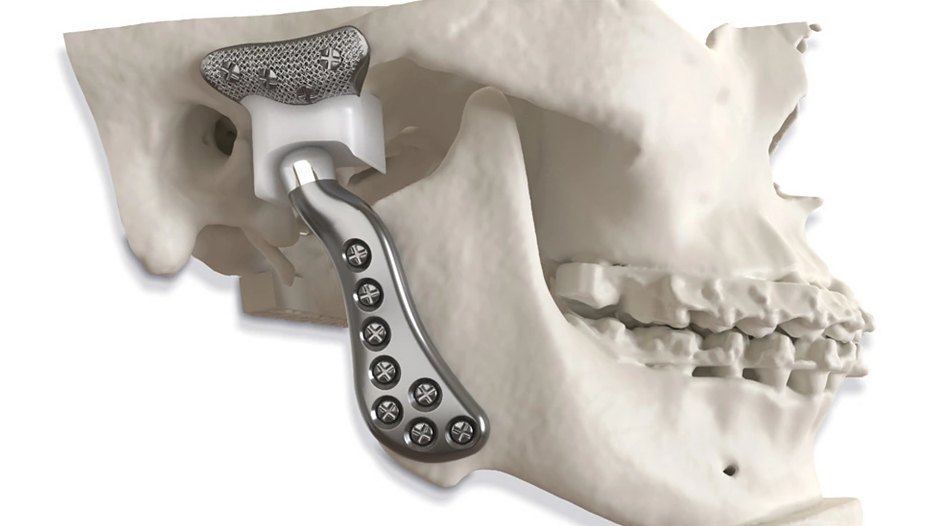
- Custom (Stryker TMJ Concepts)
- Designed and manufactured for one patient from a CT scan, so each component matches that patient's bone exactly. Custom joints suit anatomy changed by earlier surgery, resorption, or deformity, and they allow the jaw to be lengthened or advanced as part of the same plan. Manufacturing takes several weeks after the design is approved.
- Stock (Zimmer Biomet)
- Made in a range of sizes and fitted during surgery. Stock joints suit joints with more typical anatomy and avoid the manufacturing wait.
With jaw surgery
Joint Replacement and Jaw Surgery Together
A joint that has worn away or resorbed often takes the jaw with it. The back of the jaw shortens, the front teeth stop meeting, the chin moves back, and the airway behind the tongue can narrow. Replacing the joint alone may leave that deformity in place.
When indicated, Dr. Subtelny replaces the joint and repositions the jaws in the same operation. The prosthesis restores the height of the jaw and can advance it, while the upper jaw and chin are moved as needed for the bite, the face, and the airway. The joint, the jaw movements, the surgical splints, and the custom prosthesis all come from one virtual surgical plan. The bite is then set on stable joints, and the patient has one anesthetic and one recovery instead of two. Corrective jaw surgery
Process
From Evaluation to Recovery
Evaluation and Records
Examination, CT and MRI imaging, photographs, and a review of earlier treatment. For combined cases, digital scans of the teeth and coordination with your orthodontist.
Insurance Authorization
Joint replacement is billed to medical insurance and needs prior authorization. Our office prepares the documentation and handles appeals if a plan denies the first request.
Planning and Manufacture
Dr. Subtelny plans the operation in three dimensions on your CT scan. For a custom joint, the prosthesis is designed from that plan and manufactured over several weeks. A stock joint is selected and fitted during surgery.
Surgery
The joint is reached through an incision hidden along the inner surface of the ear and a second incision in a natural crease below the angle of the jaw. Most patients stay in the hospital for one or two nights.
Recovery
Jaw exercises and physical therapy begin soon after surgery and are the most important part of recovery, because they determine how well the new joint opens. The diet advances from soft foods over the following weeks, with regular follow-up throughout the first year.
Referrals
For Referring Surgeons and Physicians
Dr. Subtelny accepts referrals for end-stage joint disease, ankylosis, failed alloplastic implants, condylar resorption, and inflammatory arthritis of the joint, including patients who need joint and orthognathic reconstruction together. Referring surgeons receive the consultation findings and the surgical plan, and patients return to the referring office for ongoing care. Information for referring doctors
Questions
Common Questions
How long does a TMJ replacement last?
Modern TMJ prostheses have been followed in published studies for more than two decades with stable results in most patients. Like hip and knee replacements, they are designed for long-term use.
Is a custom or a stock joint better?
Neither is better for everyone. A custom joint fits anatomy changed by earlier surgery, resorption, or deformity, and allows larger jaw movements in the same operation. A stock joint suits more typical anatomy and avoids the manufacturing wait. Dr. Subtelny uses both and recommends one after reviewing your CT scan.
Can just one side be replaced?
Yes. One or both joints can be replaced, depending on the disease. When only one joint is affected, the healthy joint is preserved.
Will my jaw move normally afterward?
Opening and chewing usually improve. Side-to-side movement of the jaw is typically reduced after replacement, and most patients adapt to this without difficulty.
I have already had several TMJ operations. Can I still have a joint replacement?
Often, yes. Many patients who need a replacement have had earlier joint surgery or implants. Bring your operative reports and imaging to the consultation.
Is TMJ replacement covered by insurance?
Joint replacement is billed to medical insurance, and coverage varies by plan. Most plans require prior authorization, and some deny the first request. Our office prepares the documentation, submits the request, and handles appeals when needed. Insurance and costs
Next step
Talk It Through in Person
Consultations in Paramus and Old Bridge, New Jersey. No referral is needed.